
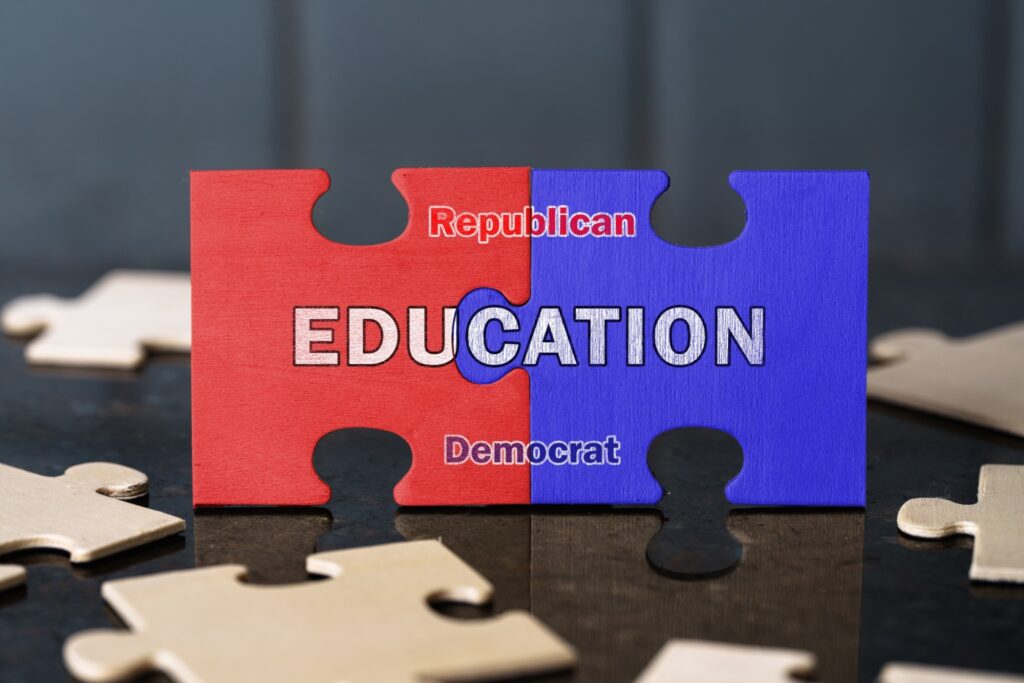
Everything is political these days. From religion to sports to entertainment – political commentary is inescapable. Of course, a college campus is no exception. And as a venue for open dialogue and free thought, it shouldn’t be.
Perhaps politics on UNC’s campus comes up most frequently in discussion of Carolina’s School of Civic Life and Leadership (SCiLL). Proponents of SCiLL argue that conservative political views are underrepresented and sometimes unwelcome at universities. They believe a school like SCiLL will help prevent the campus from becoming an institution that solely advocates for liberal ideology. Opponents think the opposite and find SCiLL to be a conservative indoctrination center itself.
A recent study by researchers at Brown University and the University of Michigan indicates that this inclination to believe that universities are indoctrination centers is flawed and inaccurate, and that faculty views do not go on to dictate the views of the students they teach.
As the study’s summary details:
“We study whether Democratic college professors make their students more liberal. We link voter data to salary records from 33 state flagships and show that faculty skew Democratic, especially in the humanities and social sciences. We then use student transcripts from one flagship to estimate causal effects. Students become more liberal during college regardless of major and sort toward ideologically similar instructors. Exploiting plausibly random variation in when instructors teach courses, we find no effect of faculty partisanship on student partisanship. Text analysis shows exposure to liberal topics reflects student demand rather than instructor supply, leaving little room for indoctrination.”
You can read the full 58-page report here.
Interestingly, The Chronicle of Higher Education reported on a new study that yielded different findings. The Chronicle writes:
“Changes in political orientation differ sharply by field. Students in the humanities and social sciences move substantially to the left during college. Students in business and economics, by contrast, change little and remain among the most right-leaning groups at graduation. Students in engineering, the natural sciences, health, and education fall between these two poles: They move somewhat left, but less than students in the humanities and social sciences.”
These findings led to the conclusion that “fields of study appear to play a causal role in shaping students’ views.”
While the authors call this effect “causal,” there is a bit of a caveat to that assertion. It doesn’t appear that staunch conservatives are taking a few classes with liberal professors and winding up liberal. The data indicate that students’ politics tend to guide their studies, rather than their studies guiding their politics.
“Students tend to select fields that align with their pre-existing political orientations,” they write. “As a result, the dispersion of political orientations increases during college.”
After considering both studies, it seems the best way to open students’ minds isn’t to confine them to the curriculum of a single school – it’s to challenge them to occasionally try courses outside of their normal area of interest and to encourage them to surround themselves with a diversity of viewpoints not only through their courseload, but also in their extracurricular activities and living environments.
We’re proud of Carolina’s diversity and believe that our campus is fostering that sort of environment. We wish students a happy fall semester as they embark on the 2026-2027 academic year and encourage them to challenge themselves in the months ahead.