

The changing of the seasons is here – if you are fortunate to call North Carolina home, certainly your sinuses confirmed that. At the Coalition for Carolina, we are hoping this time of transition will lead to positive changes for our alma mater as well.
Last month’s primary election season in North Carolina brought an earthquake, when a longtime Senate leader lost his seat in what will surely prove to be a consequential election. Now North Carolina is entering a new legislative session where we are still overdue for a state budget – the absence of which has produced many headaches and unanswered questions for state-funded institutions like the University of North Carolina.
Much of Carolina’s success is dependent on commitments from our state leaders. Both the state House and Senate were massively reshaped following the 2010 election, and for the past 15 years, Carolina has faced numerous hardships at the hands of a state legislature that didn’t prioritize education as it had in the decades and even centuries before. We are hoping the coming session and the years that follow will lead to more collaboration, cooperation and the prioritization of our public universities – especially our esteemed flagship in Chapel Hill.
NCGA Record on Higher Ed, 2011-2025
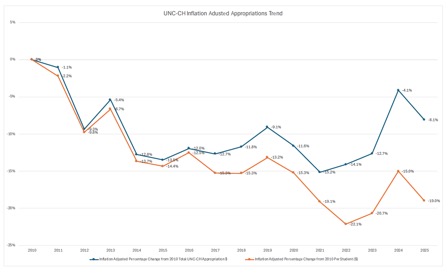
Public education is mandated by the North Carolina Constitution. But under legislative leadership since 2011, public education funding has suffered, and Carolina is a prime example. See the graph below for appropriations to UNC-Chapel Hill over the past 15 years. When adjusting for inflation, we’ve seen university funding fall below 2010’s appropriation every single year. When you look at change in funding per student, the drop is even more dramatic – now 19% lower than what it was in 2010 on an inflation-adjusted basis. That drop in funding happened at the same time state tax revenue was increasing rapidly – from $30.8 billion in 2010 to $47.4 billion by 2025 when adjusted for inflation, representing a 54% increase over that time period.
State appropriations as a percentage of UNC-Chapel Hill’s overall budget has also fallen markedly. From 2010 to 2025, University revenue doubled – from nearly $2.4 billion in 2010 to over $4.8 billion by 2025. State appropriations, on the other hand, only crept up from $510 million in 2010 to $690 million in 2025 – bringing state appropriations as a percentage of overall revenue down from 22% in 2010 to 14% in 2025.
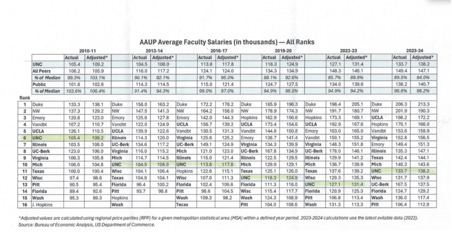
UNC faculty salaries have also failed to keep pace over the past 15 years. In the 2010-2011 academic year, UNC-Chapel Hill ranked 6th for average faculty salaries among public and private peer institutions – in the top quartile. That year, UNC faculty made on average $109,200 a year to Duke’s average of $138,100.
And now? Duke’s average has catapulted to $213,300 while UNC’s has risen to only $138,200 – almost identical to what Duke paid its faculty 15 years ago. Also during that 15-year span, schools including Texas, Michigan and Virginia have surpassed UNC in faculty pay when they once lagged behind us. As a result, Carolina’s faculty pay has fallen to the bottom quartile among peers.
And as funding fell, the prominence of politics in university governance grew markedly. Legislative leaders placed political allies in positions of power throughout the UNC System, including as members of the UNC Board of Governors and the UNC-Chapel Hill Board of Trustees.
In 2016, the legislature stripped the governor’s ability to appoint members to the UNC Board of Trustees. Then in 2023, a state law was enacted to change appointments to the UNC Board of Governors and increased appointments to the UNC-Chapel Hill Board of Trustees from 13 to 15, while increasing General Assembly appointments from 4 to 6.
In 2020, the Board of Governors approved changes giving the UNC System president more authority to shape chancellor finalist pools, reducing the independent role of campus-level processes which increased the chance of politicized leadership selections. These and other policy changes strengthened legislative and political influence over higher education in North Carolina.
While we have great respect for many past and present members of both the UNC System Board of Governors and the UNC-Chapel Hill Board of Trustees, a handful of recent legislative appointees have been the source of a myriad of harms to higher education in our state.
We’ve covered the troubling actions of the UNC Trustees thoroughly – from meddling in university admissions and the hiring process of Bill Belichick, to repeatedly delaying tenure votes for deserving faculty and fast-tracking the approval of the controversial School of Civic Life and Leadership (SCiLL) outside of normal procedure. The harms they have inflicted on UNC have been widespread and all too frequent.
Carolina’s Resilience & Recognition
Through it all, our University and its incredible faculty, staff and students have been resilient – making due with less than many of our peers while still earning top marks and garnering national and international recognition.
A dozen Tar Heels have been named Rhodes Scholars since 2010, including three students in 2025, making UNC-Chapel Hill No. 1 for Rhodes Scholars among public universities. Carolina was also the No. 1 public university for Fulbright U.S. Student Program awards last year, and we even count a Nobel Prize winner among our faculty, with UNC Professor Aziz Sancar being awarded the Nobel Prize in Chemistry in 2015. Earlier this month, it was announced that UNC made the Forbes list of “new Ivies” for the third straight year.
While the aforementioned resilience of our Carolina family is admirable, we can only imagine what heights we could have reached with a stronger commitment from a state legislature that once held great pride in public education.
Governor Stein has demonstrated his commitment to working across party lines with the state legislature, and a change in leadership in the state House last year provided an opening for new bonds to be built. Now, we are facing the same crossroads in the state Senate as this session begins and new leadership will take charge next year.
In this season of change, we’re hoping whatever lies ahead for state government will lead to better funding, less politicization and an even brighter future for the University we love.