
We’ve recently written about several topics that affect UNC faculty’s ability to teach and speak freely. A new campus recording policy, a new syllabi policy and a likely new definition of academic freedom are just a few things faculty members are grappling with at the moment.
The world is changing quickly. While many of us experienced an educational environment where free thought and community were encouraged, higher education faces more challenges today in a hyper-online, politically fraught world.
The following is a note from Coalition for Carolina co-founder Professor Mimi Chapman. Her experience on campus is enlightening, and we encourage you to read and reflect on what she has to say.
From Mimi:
Earlier this week, I found myself committing to write something about what it felt like to be a faculty member at Carolina these days. I’ve scribbled here and there trying to put some thoughts together, but it’s harder than I thought it would be.
In the midst of learning that we can be recorded without our knowledge in our classrooms by our administration, being instructed to put syllabi in a repository to be searched by the public, worrying that we might be recorded without our knowledge by students, learning that the Board of Governors will vote Friday on a definition of academic freedom rather than relying on the AAUP definition that has stood the test of time, all while following faculty firings for various types of speech around the country, what is the word that best describes what it’s like to be a faculty member right now? Exhausted? Outraged? Resigned? Angry?
Maybe all the above.
But for me, the word is lonely.
For years, this campus has described itself as a place of “low stone walls,” reflecting a culture of collaboration across departments and disciplines. A way of working that one colleague once referred to as “the stone soup method.” You’ll remember the children’s story where each person in a town brings what they have – an onion here, a carrot there, all around the base of a simple rock – and with time, a nourishing soup develops despite a seeming famine. At Carolina, we may not have had as many resources as some competitor institutions. Still, the sense of pulling together – faculty, administration, students, governing boards, alums, donors – around shared values and goals allowed us to punch well above our weight in all aspects of campus life.
These days, whether real or perceived, many faculty members feel they are on their own, unsure who will have their back if a difficult situation arises. Many newly retired faculty tell me how relieved they are not to be in the classroom, concerned that they could be inadvertently caught up in a social media-propelled whirlwind generated by the right or the left. Faculty I know at other campuses are receiving “infiltration training” so that they can be alert to people who appear to be genuine in their interest in a faculty member’s work or role but are seeking to “get them on record” saying something that can be taken out of context and weaponized.
On the one hand, my thought is sign me up. We all need such training tomorrow or maybe yesterday. On the other hand, I am sick that I or anyone should feel so distrustful of the environment where we live and work.
Indeed, when a person feels untrusted, they begin to distrust others – their colleagues, their students, their leaders. Taking chances, chances that produce new collaborations and discoveries, suddenly seems far riskier. It is easier to retreat to what we know – corners of campus that feel far away from the public eye, to be less involved with those we don’t know, no matter what role they occupy. Such feelings are completely reasonable in a higher education environment – local, state, or national – filled with uncertainty and threat. And when leaders at every level make decisions without adequate process and transparency, the university as a place to discuss new ideas, to welcome all kinds of life experiences, to ask hard questions, and to have fun doing it, is undermined.
The new academic freedom definition – to be voted on Friday by the Board of Governors – warrants special attention. The definition adds to an ill-fated attempt by faculty from across the system to create a definition that the BOG could live with. The idea was that by providing a more specific definition than the AAUP definition, we could somehow ward off something worse.
Nice idea.
The UNC System has further specified the faculty definition passed by the Faculty Assembly in October. Whether you like the final product or not, the process, as per usual, was flawed, and we will soon have in place a definition that could box in faculty speech and punish those who veer outside the stated parameters. Only time will tell how it will be interpreted and used.
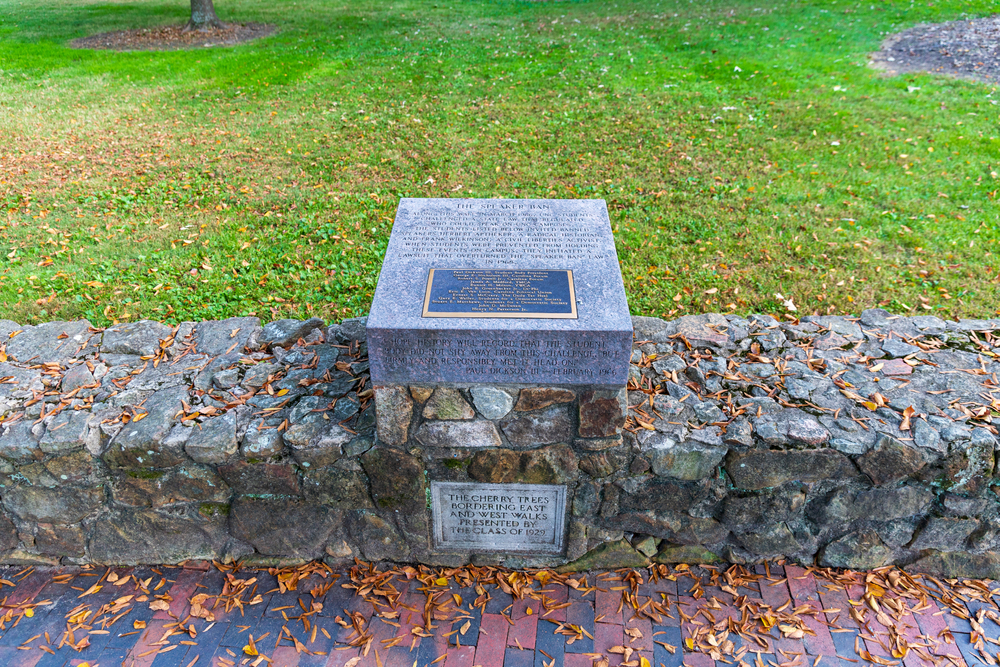
A friend who predates me by a few years at the university sent along some related recommended reading. It is the court ruling in the Speaker Ban case, an event that runs deep in Carolina’s memory. In 1963, the legislature insisted that speakers with particular views could not speak on the Carolina campus. Like today, people were worried about student indoctrination. Protests erupted. Yet faculty and students were not alone. The administration stood firm with them. And eventually, the courts ruled in their favor.
As my friend put it, “telling people what they can say, listen to, or read is a fool’s errand.”
No doubt we are all busy agonizing over the Dean Dome and the development at Carolina North. Yet, for me, those are the least of our worries. The American University became the envy of the world because of its unfettered academic freedom. Carolina became an academic powerhouse because we grappled with the hard stuff together, not because we tried to wall off hard questions through overly specific definitions and a fearful, isolating climate.
We are in a hard time – for faculty, administrators, staff and students. And I certainly have no answers to offer. But if you, like me, try your best to focus on what is joyful in your work, but still find yourself feeling a bit at sea, know, at the very least, that you are not alone.