
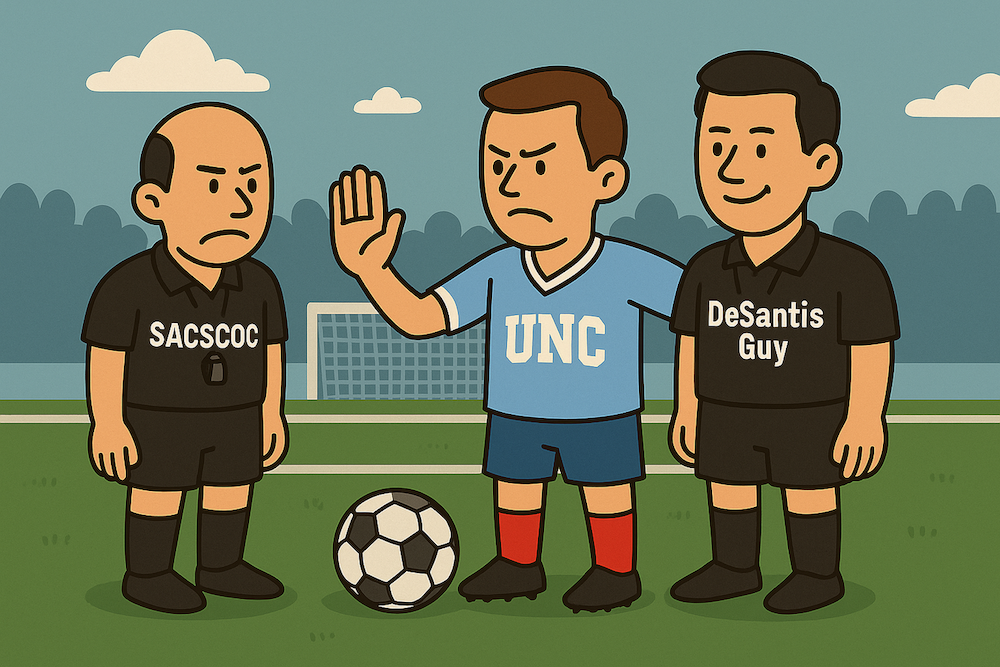
We received overwhelming response to last week’s newsletter about recent threats to the independence of Carolina’s alumni association.
This week, we wanted to cover another topic that has been in the news recently but perhaps isn’t getting the attention it deserves: the overhaul of university accreditation.
The Southern Association of Colleges and Schools Commission on Colleges (SACSCOC) oversees accreditation of hundreds of schools across an 11-state region, including North Carolina’s UNC system.
SACSCOC previously made news back in 2023 for how it responded to the formation of UNC’s School of Civic Life and Leadership (SCiLL).
SCiLL – mired in controversy and turmoil since its inception – caught the attention of accreditors when UNC Trustees created the new school without consulting UNC faculty. This is a stark departure from the standard practice of faculty leading the development of new programs, which caused SACSCOC to send a letter of inquiry (standard procedure for decades) asking for some information about SCiLL’s formation since the accreditor knew nothing of this new school prior to its approval. Any new degree granting part of the University should get an OK from its accreditation body, whether it be SACSCOC or some other accrediting entity. The Board of Trustees and its political allies did not appreciate SACSCOC’s inquiry, and since the incident, SACSCOC has been a target of right-wing political activists.
Now, they’ve got their alternative: The Commission for Public Higher Education.
This new body is championed by Florida Governor Ron DeSantis as a way to “upend the monopoly of the woke accreditation cartels.”
UNC System President Peter Hans and the Board of Governors have signed on with this new accrediting body, as have several other Southern states.
Hans said of the move:
“We need an accreditor that understands that environment, can work well with our public universities, and really, most importantly, one that’s focused on academic quality and student outcomes. That’s the most important role for an accreditor.”
But, as we’ve seen all too often, efforts that masquerade as depoliticizing a governing body often do the opposite.
Norman Loewenthal, former director of The William and Ida Friday Center for Continuing Education at UNC, criticized the move in a recent letter to the editor:
“Apart from the notion that universities might anoint the entities that set standards and enforce them, the proposed agency would be at odds with the values of which UNC was once respected. Prominent among those values, epitomized by the legacy of William Friday, are freedom from political interference and ideological or anti-intellectual conformity and the principle that the university belongs to and serves all the people of the state and not a particular political faction.”
We want to hear from you. What are your thoughts on this new accreditation board? How do you think it will affect Carolina? What concerns and questions do you have? Send us a note at contact@coalitionforcarolina.org.